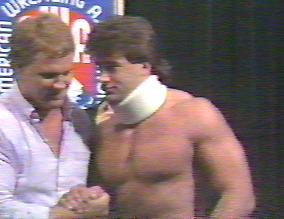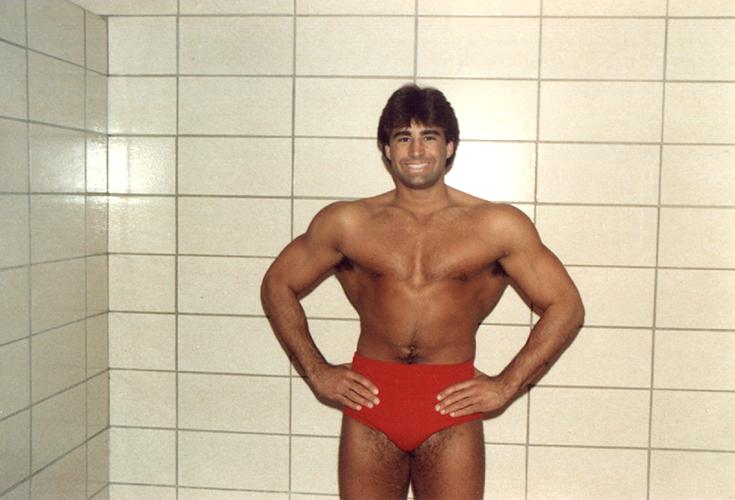
In January 1984, Tom Zenk debuted in Skip Sponsel's short lived independent promotion USA Pro. After the promotion folded, Zenk did a brief tour of Bill Watts' Mid South before returning to Minneapolis and the AWA. In AWA, Gagne demanded from Zenk "a 100 per cent commitment to wrestling" involving not just a physical commitment to taking bumps but mental preparation for the humiliation of endless jobbing in preliminaries - the ritual induction into wrestling known as "paying your dues." In return for this "100 per cent commitment", a journeyman expected fair treatment from the promoter in the form of frequent bookings and gradual movement up the card. But, as Zenk was quick to discover, in the family-run AWA, it wasn't going to be quite so straightforward.
* * *
Part 2 - Wrestling historians Morton and O'Brien have noted that, in the unregulated laissez- faire world of wrestling - "Promoters exercise control and conformity by the number of bouts a wrestler gets - that is, the number of chances he gets to work....Wrestlers are cowed by the threat of economic deprivation with fewer matches or no promoter willing to hire them if they ... buck the system and its pecking order." (1985; 69)
Promotions particularly welcomed the pliability of 'married and mortgaged' wrestlers over men without family or financial commitments. Where possible, promoters avoided single men (unless already members of their family), kept them in the lower card (where their defection could go unnoticed) or encouraged them to over-extend themselves financially to ensure continued 'loyalty' on terms dictated by the promoters. (So, for example, when WWF decided to keep Zenk in 1987, they didn't offer him more money - they tried to persuade him to buy a more expensive house).
At the same time, whatever skills a journeyman brought to the promotion were generally undervalued by promoters keen to generate a sense of obligation among rookies for "teaching them everything they knew about the business." Gagne was no exception.
"The first problem with Tom Zenk was that he was a bodybuilder, not a wrestler," Gagne noted, "and we had to teach him to move around the ring - gracefully! The next problem was to get him to Think like a professional wrestler," Gagne continued," and finally, he had to unlearn all the bad wrestling habits he developed wrestling with his friends in the gym" (Heyman, Wrestling Scene, 1985).
Despite this, Heyman reported, Tom was graduated at the top of his class.
"After graduation Tom spent several weeks going to all the matches on the AWA circuit. "I spent some time with World Champion Rick Martel," Zenk stated, "and he is really a great champion and a fine friend." When asked about the up-and-coming bodybuilder-turned-wrestler, Martel responded, "Tom is one of the best prospects in wrestling today. He has youth, he has speed, and he is willing to get in there and learn the hard way, by taking his lumps!" (Heyman, Wrestling Scene, 1985).

Finally, in August 1984, with some additional coaching from Olympian Brad Rheingans, Tom made his AWA debut against veteran Jimmy Doo in LaCrosse, Wisconsin. It was usual to pair a journeyman with an established veteran whose role was to help the rookie work comfortably before a large crowd and cover any mistakes caused by inexperience or nervousness ("it's very hard not to be nervous when you first start out, it's like stage fright, I guess.")
According to Paul Heyman, the debut match ended when "Tom pinned the experienced Doo with a series of fantastic scientific maneuvers......
But not every night has been so rosy for the twenty five year old since his debut. Like any young wrestler, Tom has had to take his lumps. He has been brutalized by Kendo Nagasaki ("one of the worst nights of my life was the night I tried to go to sleep after facing Kendo Nagasaki. I was black and blue from head to toe!"); tortured by Mr. Saito ("they call him Mr. Torture, and it's pretty obvious why"); and battered around by Jimmy Garvin ("he really got me mad because he was so arrogant about things. One day, I'm going to even the score!") (Heyman, Wrestling Scene, 1985.
Heyman reported "Tom doesn't complain. He knows that even in defeat, he gains valuable experience. "There's no easy road to success," he reasoned, "and there's not a wrestler alive who didn't go through this. It's called 'learning the ropes!"
"Tom Zenk is learning those ropes rather quickly, as he has survived his "tests" against some of wrestling's toughest and most brutal men And although he has been wrestling for less than a year, he is already being touted as a future champion!" (Heyman, Wrestling Scene, 1985)
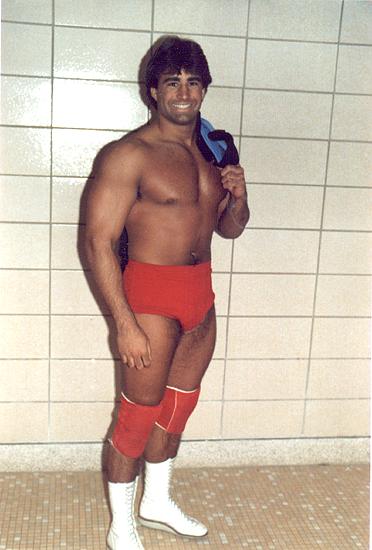
The reluctant 'face'
Having started to master the technical aspects of wrestling, Zenk's next job was to develop an in-ring persona. In some circumstances, this responsibility falls to the wrestler himself but more often, is determined by the booker/promoter. While Zenk's own inclination was to play 'heel', Bockwinkel argued that men with Zenk's looks and physique were rare in wrestling, making him a natural 'babyface'.
So, on Bockwinkel's recommendation, Zenk began his ring career as a 'face' - but at the very moment that America was re-discovering the 'anti-hero' and wrestling historians Morton and O'Brien were warning "wrestling good guys are reminders of the older, unambiguous, clean cut heroes found in a less complicated, less cyncial America.... such heroes are no longer looked up to as models in everyday life" (1985; 65).
Through the second half of 1984, Gagne booked Zenk on average two to three nights a month. Gagne had a reputation for paying his wrestlers fairly, with Zenk earning around $700 per night. Tom supplemented this with night-club bouncing (at $50 a night). Wally Karbo told him "Sure, go and do bouncing, but if you ever get beat, don't come back here". His approach to bouncing was to let troublemakers know "you're bigger than me and we don't want to fight" - but if they persisted, Zenk would turn them round and clamp on a sleeper hold.
As a young journeyman Zenk spent much of 1984 "paying dues" in preliminary bouts (see AWA Match Results). In general, established stars were reluctant to work with journeymen, partly because defeating a rookie added little to their prestige. But there was also a heightened risk of being injured by a new worker or upstaged by a younger man anxious to get ahead. Despite this, Zenk received the rare compliment of being booked with top AWA performers. According to Zenk - " I think I was cut a lot of slack sometimes because I was humble around the boys - and in the AWA I was from Robbinsdale like the rest of the guys, Vern Gagne, Larry the Axe, Curt... "
Bookings included numerous matches against AWA Heavyweight Champion Nick Bockwinkel, AWA Light Heavyweight Champion Steve Regal, Harley Race, Jimmy Garvin, Michael Hayes, Super Destroyer Butch Reed, Larry Zbyszko and the veteran Ray 'Crippler' Stevens.
" Harley Race was the best of the best, smooth, like a feather, great timing and great pace in the ring"
"Steve Regal (AWA light heavyweight champion) was a really great worker for a rookie to work with. He could set your mind at ease, talk to you in the ring, and go at a pace you could follow and not blow up." Jimmy Garvin was similarly easy to work with. Bockwinkel sold for Zenk generously in a memorable televised match, but Zenk found Bockwinkel " clunky to work with when compared to [former AWA Heavyweight Champion] Harley Race. Harley was the best of the best, smooth, like a feather, great timing and great pace in the ring. Harley had it all, just what the promoters wanted."
In tag action Zenk teamed with his friend Curt Hennig against competition including AWA Tag Champions The Road Warriors, The Freebirds and the team of Bockwinkel and Mr Saito.
By the end of 1984 people were beginning to take serious notice of Tom Zenk's ring work. Dave Meltzer's Wrestling Observer Newsletter recognized Zenk's talent early, jointly awarding both Zenk and Keiichi Yamada (Jushin "Thunder" Liger of New Japan Pro Wrestling) the 1984 "Rookie of the Year" Award. The AWA responded, awarding Zenk the title of most improved wrestler in the promotion. Meanwhile a wrestling newsletter of the time (August 1984) speculated that "as Steve Regal moves on (possibly before year's end) Zenk will be the new AWA light heavyweight champ."
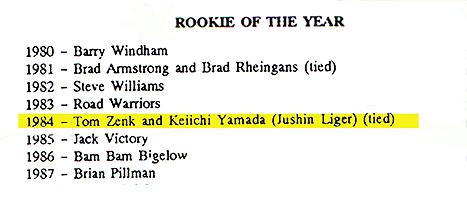
Wrestling Observer Newsletter
"there was simply no question of Gagne pushing Zenk to top babyface ahead of his own son Greg "
Despite this, there was never any real chance that Zenk would prosper in the Gagne family promotion. Hogan had abandoned AWA in late 1983 in frustration at failing to be pushed over the ageing Bockwinkel. It remains an open question how Bockwinkel came to be so carried away by the moment, so blurred in his judgement, as to refuse to let Hogan beat him for the belt. But the final responsibility lay with Verne Gagne whose booking had always been heavily influenced by ties of family and friendship.
Typecast as a 'face', there was simply no question of Gagne pushing Zenk to top babyface ahead of his own son Greg or Larry Hennig's son Curt. In the unlikely event that imaginative AWA booking had cast Zenk as 'heel', there was, again, no question of him ever being pushed ahead of Gagne's son-in-law Larry Zbyszko. As Jim Brunzell told Zenk, Minneapolis MN was 'Gagne town.' To work in MN at all, Zenk was forced to accept billing "from Phoenix (or Tempe) Arizona." There could only be one spot for a 'home town hero' in AWA - and that spot was reserved exclusively for Greg Gagne.